
Owner Experience vs Customer Experience

Customer Experience is the current tagline for everything a customer experiences when interacting with a supplier’s brand, products, and interfaces (human and digital). The actual customer experience is trying to manage a portfolio of disconnected services delivered by many suppliers, each focused on one narrow aspect of the overall need and all competing for attention. No one supports the owner’s primary goal – to easily acquire, use and look after an asset throughout its life.

Omni-channel is the current big thing in customer contact technologies that drive much of this experience. Offer customers many different channels to engage with the supplier. Synthesise all of the interactions in real time to maintain a ‘single view of the customer’ across the different customer touch-points and contact types through all stages of the customer journey.

Single View of Customer

To achieve this goal, a supplier needs a continuous stream of data; therefore, customer engagement must be as digital as possible. Digital agents are employed to manage the digital channels and as a bonus lower costs through automation and data processing efficiencies (for the supplier – not necessarily for the customer).

In most scenarios, the customer journey is that of a human, and often the goal of the human is to find and buy something and then ideally enjoy the use of that thing. Suppliers go to great lengths to make the customer’s journey with them as painless as possible; however, never question the assumption that the customer experience has to occur through their digital interfaces.

Customer interfaces are designed with humans in mind; however, they are tested in artificial conditions, assuming they have the user’s undivided attention. The interfaces are also judged on their ability to enable the customer to be served by the supplier – which is never the customer’s real goal.

The actual ‘customer experience’ is someone having to deal with many different suppliers employed to fulfil a narrow role, each pushing many different channels. The end goal of the customer is to enjoy something that depends on an ecosystem of suppliers to ensure that it continues to function and remains healthy. It isn’t to enjoy going through yet another registration process with yet another supplier that I will never have a ‘relationship’ with.
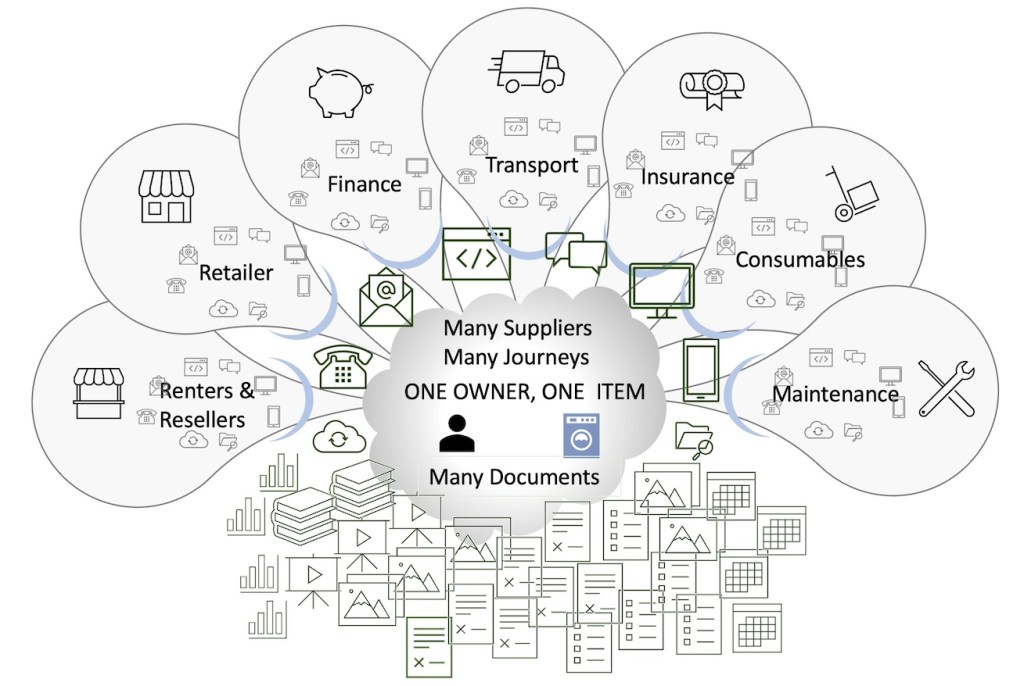
Owner and Item View

For each thing I own, I am subject to an array of omnivorous suppliers, all of whom are ‘offering’ me the opportunity to engage with them through one of many digital interfaces. Human-to-human interfaces are a last resort or costly luxury if they exist.

The supply of consumer goods and services has reached incredible levels of efficiency, offering an astounding abundance and variety of increasing specialisation and tremendous economies of scale. We’ve had fifty years of progress digitising old customer service models and transforming the customer experience of each supplier.

As responsible owners, it’s time we transform our experience. We cannot continue to take on more and more work, install more apps, to spend our time managing the supporting ecosystems for each of the things we care about. I’m looking for a supplier who cares about the owner experience – not one collecting more customer experiences.

The Great Digital Engagement Pandemic

Current approaches for business-to-consumer digital engagement are doomed. Self-service is great for businesses but doesn’t scale for consumers.

The advent of Covid led to unprecedented acceleration and adoption of digital business-to-consumer interfaces. There’s not much better ‘burning bridge’ than the prospect of your existing customer service model being fatal to your customers and staff. And just in case even this wasn’t enough of a change catalyst, some governments actually made it illegal to offer human customer service contact.

‘Contactless’ service is just that – service delivered to a human via a digital intermediary. While this model came of age during the pandemic, it had been growing from an immature, clumsy adolescent struggling for acceptance for over 15 years. The early drivers for digital transformation were, and to some extent remain, service delivery and business process efficiency. It isn’t usually about giving people a remarkably higher quality service for less – it’s about giving people the tools to access a consistent, reliable, reasonable quality service at a competitive price.

While digitally enabled services may appear less expensive, they come at the rapidly increasing cost of our attention and time – our most precious, scarce resources.

Over the last twenty years, digitisation and systems integration within and across business and government has delivered productivity gains and enabled new, sophisticated service offerings. Most of this has been achieved by automating tasks and making it easier for different computer systems to work together. Digital interfaces are designed to facilitate and optimise integration between digital things – not humans. Not surprisingly, most of today’s consumer-facing service delivery channels treat people as if they are a system on the other side of a digital interface.

By introducing a digital intermediary, service providers remove their side of the empathetic, messy unstructured human-to-human interface of traditional customer service. As more customer interaction occurs through digital engagement channels, organisations have found that they can ‘serve’ more customers at a lower cost with less staff by getting consumers to deal directly with the organisation’s computer systems rather than their people.

Human-to-human customer service isn’t going away – it will however continue to gravitate to more exclusive premium value interactions where the high cost and ‘inefficiency’ can be adequately rewarded. For the rest of us, our fate is clear – we are doomed to serve ourselves.

We have become self-service ‘Mechanical Turks’; poorly paid, gig-working data entry clerks, operating hundreds of different computers every week. Usernames, passwords, apps, electronic forms, automated SMS messages, chatbots, OCR codes, interactive voice response phone systems, biometric checks, and auto-generated emails are some of the computer interfaces we use every day to access the services we need and/or want to help look after the things we care about.

In the early days of the digital engagement model, there were clearly times when we could do things more easily and quickly ourselves than have to navigate through our supplier’s maze-like customer service bureaucracy. Digital transformation efforts could be seen as a win/win for providers and consumers.

The problem is that this model stops being viable for the consumer as the number of services and providers increases – and in today’s service economy they are increasing exponentially. Our ability as individuals to operate more and more computers every week just doesn’t scale. There’s a limit to the number of apps you can use – more for some, less for others, but still a limit.

Maybe you can already hear the early warning bells – more apps lead to more notifications – some of which share the same alarm tone… is my bank balance low, has my food left the restaurant, is someone breaking into my car, has a bid been made on my eBay item, or is dog food on special this week? Maybe all of the above! This design fails basic human factors alarm management 101. It wouldn’t be allowed in a control room – why accept it when you are trying to control your life?