
Owner Experience vs Customer Experience

Customer Experience is the current tagline for everything a customer experiences when interacting with a supplier’s brand, products, and interfaces (human and digital). The actual customer experience is trying to manage a portfolio of disconnected services delivered by many suppliers, each focused on one narrow aspect of the overall need and all competing for attention. No one supports the owner’s primary goal – to easily acquire, use and look after an asset throughout its life.

Omni-channel is the current big thing in customer contact technologies that drive much of this experience. Offer customers many different channels to engage with the supplier. Synthesise all of the interactions in real time to maintain a ‘single view of the customer’ across the different customer touch-points and contact types through all stages of the customer journey.

Single View of Customer

To achieve this goal, a supplier needs a continuous stream of data; therefore, customer engagement must be as digital as possible. Digital agents are employed to manage the digital channels and as a bonus lower costs through automation and data processing efficiencies (for the supplier – not necessarily for the customer).

In most scenarios, the customer journey is that of a human, and often the goal of the human is to find and buy something and then ideally enjoy the use of that thing. Suppliers go to great lengths to make the customer’s journey with them as painless as possible; however, never question the assumption that the customer experience has to occur through their digital interfaces.

Customer interfaces are designed with humans in mind; however, they are tested in artificial conditions, assuming they have the user’s undivided attention. The interfaces are also judged on their ability to enable the customer to be served by the supplier – which is never the customer’s real goal.

The actual ‘customer experience’ is someone having to deal with many different suppliers employed to fulfil a narrow role, each pushing many different channels. The end goal of the customer is to enjoy something that depends on an ecosystem of suppliers to ensure that it continues to function and remains healthy. It isn’t to enjoy going through yet another registration process with yet another supplier that I will never have a ‘relationship’ with.
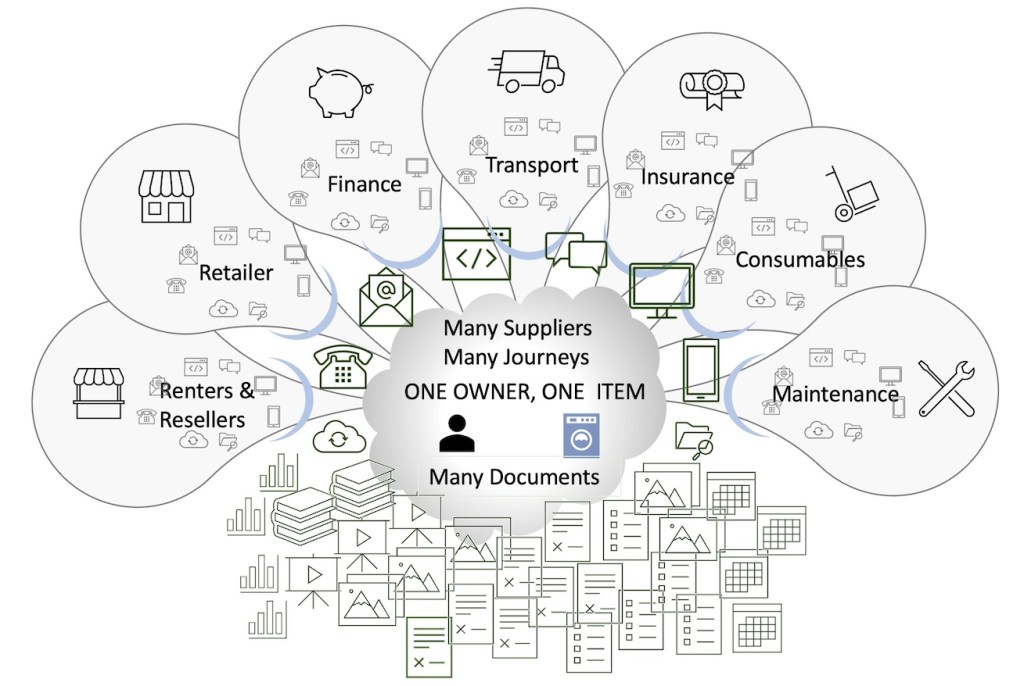
Owner and Item View

For each thing I own, I am subject to an array of omnivorous suppliers, all of whom are ‘offering’ me the opportunity to engage with them through one of many digital interfaces. Human-to-human interfaces are a last resort or costly luxury if they exist.

The supply of consumer goods and services has reached incredible levels of efficiency, offering an astounding abundance and variety of increasing specialisation and tremendous economies of scale. We’ve had fifty years of progress digitising old customer service models and transforming the customer experience of each supplier.

As responsible owners, it’s time we transform our experience. We cannot continue to take on more and more work, install more apps, to spend our time managing the supporting ecosystems for each of the things we care about. I’m looking for a supplier who cares about the owner experience – not one collecting more customer experiences.

Digital Twins – Separated at Birth

Imagine a digital representation of an object that includes every bit of data ever associated with it or related to it. I think this gets closer to a real digital twin than today’s pretenders. The emergence of these twins will give rise to unimaginable opportunities for the blended digital and material world in a true internet of and by things.

Today’s digital twins’ are like long-lost siblings, separated at birth, popping up in our network with chat messages and occasional photos. Our familiarity is less than superficial, and in the absence of a genuine relationship, we invent one. We don’t know where they’re from, what kind of life they’ve led, or whether they are actually related to their physical doppelgängers.

The typical twin family portrait is that of a big screen or AR goggles with a ‘live’ 3D view of a factory and machines that mirror the workplace outside the control room. In reality, the twins depicted on the dashboard could just as well be on Mars and are as ‘live’ as a thermostat. Our conception of a digital twin today is 90% imagination and 10% digital perspiration.

Sense, communicate, respond, analyse & visualise computing has been around for more than 50 years. The graphics, processing speed and volume of data has improved, our imagination enriched through glimpses of what’s possible, but the paradigm remains largely unchanged.

All manufactured objects (and many animals) are associated with a constant and growing stream of bits of recorded data from the moment of conception to disposal. By the time a product reaches the hands of a consumer, terabytes of data will have been collected, analysed and stored by thousands of stakeholders in millions of systems.

At the end of that journey, the consumer gets a nice origami cardboard box and a paper booklet in 30 languages explaining how to plug it in and switch it on. Enthusiastic owners can go fossicking for digital dust sprinkled across the internet in the wake of an item’s existence while the vast golden seems of valuable data remain sealed in their caves.

The scale of our digital waste and selfishness is mind-boggling. It may be cheap to store those zeros and ones, but the cost to society of keeping all those bits and pieces of information locked away in individual vaults is that we are doing less and less with more and more stuff.

If we’re going to keep this ‘digital twin’ terminology then let’s not sell ourselves short – let go all in!

Are You a Responsible Owner?

A transition has begun in many parts of the world from mass production and consumption to responsible ownership. Interest in sustainability is raising awareness of the life story of individual products from sourcing to disposal. In this story, ours is just one of the hundreds of chapters throughout the life of the things we own.

(This is one of a series of Why Pixies, Why Now posts)

Mass production and distribution have enabled generations of consumers to experience an ever wider choice of higher quality less expensive products. Economies of scale across globally extended and integrated supply chains have dramatically lowered individual unit production and transportation costs.

In this environment, little attention is given to individual product units – we focus on categories and models because each individual unit within these sets is the same. It’s hard to feel attached to something that lacks identity and so we don’t care as much about throwing it away; particularly if you can replace it with a new model which does a better job and costs less.

Products in this category are ‘fungible’ – they can be substituted with a similar product without impacting the utility for the owner. I don’t care if you replace my can of beans with another of the same type and brand.

Recently, people have become increasingly concerned about the social and environmental impact of their mass consumption. More people care about their role as responsible consumers in areas such as ethical & geographical sourcing and production, the provenance of their food, brand (and in theory quality) authenticity, product safety, support for circular supply chains, and a product’s net cost to the environment – not just the cost of buying it.

The good news is that because mass production and distribution utilise digital channels, and the cost of data processing is close to zero, individual product item data is now being generated as a by-product of integrated supply and service chains without compromising economies of scale. The more people care about their responsibility, the more this data will be sought as an assurance of the history and qualities of the goods and services they consume. Brands that serve this need will benefit through greater loyalty and trust.

Of course, there are some kinds of products that people have always cared about. Art, antiques, collectables and bespoke hand-crafted items are examples of things with unique qualities that make them ‘non-fungible’ – i.e. difficult or impossible to substitute or exchange with something equivalent or identical.

Today, like mass-produced products, even these unique items have acquired a digital footprint as a byproduct of the digital communication and documentation generated by the people who care about them.

Uniqueness arises through a combination of identifying features, characteristics and history. As it becomes easier to establish context through a blend of physical and digital evidence, it will be more common to think about all the ‘things’ we care about as having unique ‘non-fungible’ identities. The more we see something as unique, the more likely we are to look after it.

To blend physical and digital evidence, there needs to be a common point of reference. Being self-centred consumers, we like to think that the common reference is us. But in fact, the life of a product extends over hundreds of stakeholders and our relationship with that product is just one of many in a product’s lifetime. To see the whole story, we need a through-life view with the product – not the consumer – at the centre.

The data for mass-produced items are scattered across supply, distribution, retail and service chains. Non-mass-produced item data is scattered across retail records, current and past owners, historical studies and informal interest groups. The common thread in both cases is the custody-oriented view of the data – who owns & services the item rather than the unique journey of the item through the hands of many interested stakeholders across many events.

As we gain a better appreciation of our role as responsible consumers, service providers, distributors and manufacturers, we’ll see the emergence of a new, product-centric perspective. That is, from the product’s point of view – events and contexts through its life, recorded in a verifiable, authoritative digital trail of history and stakeholder interactions.