
Identity Compromise as a Service

Yet another report of a massive leak of personal data by a large service provider in the news. No longer surprising and no sign of legitimate mitigations on offer – other than ‘be vigilant – keep on the lookout for unexpected uses of your personal information’.

Many of the posts in this series have focused on the evolution of digital service models in which consumers pay the price of attention, management oversight, and data entry effort on behalf of service providers. In addition, consumers also agree to provide personal information as a prerequisite to accessing a service to ‘authenticate’ the consumer and make it easier for the supplier to provide services through digital interfaces.

Historically we have encouraged diverse ecosystems of suppliers to ensure competition and incentivise innovation. An owner’s experience can be enhanced with a greater choice of service providers and product suppliers – particularly if our ‘relationship’ begins and ends when we enter or walk out the door. In this early digital era, we enter into a ‘relationship’ with every supplier through consensual access to our personal information as a prerequisite to receiving the product or service.

My personal information is held by thousands of suppliers who have no incentive to care for that information in the way I would. Redundant and outdated copies of my data are spread across countless data stores – I’ll never know where and most of my ‘trusted’ service providers don’t know where it is either.

In the Business to Business space, it would be ludicrous for a company to keep the corporate information of every one of their customers. A tax file number, maybe bank account or payment intermediary details – that’s all. In the Business to Consumer space, gathering as much data as possible about customers has become the norm and exploiting that data to push more sales the goal.

The much vaunted 2-factor authentication does nothing to limit the policy of consumer data scraping. It does, however, move us to the point where we’ll need to use a combination of user, password and mobile phone code every time we want to access a service – more work for the consumer and no responsibility being taken by the service provider. Passive data harvesting and analysis is still a very rewarding activity and does not require 1 or n factor user authentication.

The only way this situation will improve is for providers to accept and consumers to adopt a personal authentication agent that provides approved interface keys and negotiates and records all data exchanged with each provider. While an individual’s data can still be hacked, the damage is limited to one individual. The same hack on today’s providers damages millions of consumers.

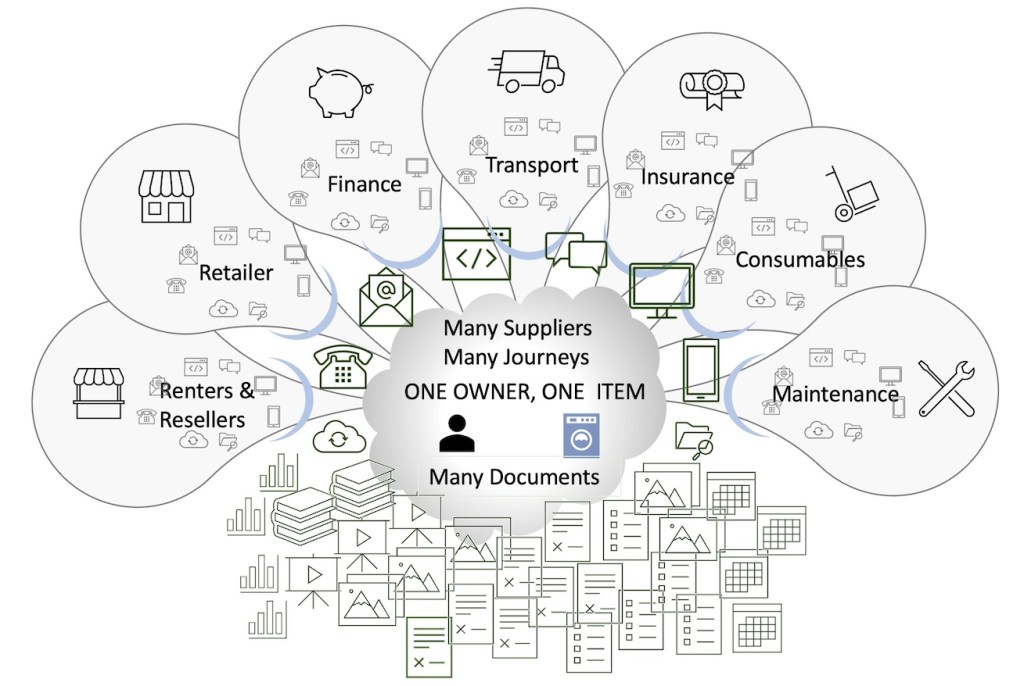
Owner Experience vs Customer Experience

Customer Experience is the current tagline for everything a customer experiences when interacting with a supplier’s brand, products, and interfaces (human and digital). The actual customer experience is trying to manage a portfolio of disconnected services delivered by many suppliers, each focused on one narrow aspect of the overall need and all competing for attention. No one supports the owner’s primary goal – to easily acquire, use and look after an asset throughout its life.

Omni-channel is the current big thing in customer contact technologies that drive much of this experience. Offer customers many different channels to engage with the supplier. Synthesise all of the interactions in real time to maintain a ‘single view of the customer’ across the different customer touch-points and contact types through all stages of the customer journey.

Single View of Customer

To achieve this goal, a supplier needs a continuous stream of data; therefore, customer engagement must be as digital as possible. Digital agents are employed to manage the digital channels and as a bonus lower costs through automation and data processing efficiencies (for the supplier – not necessarily for the customer).

In most scenarios, the customer journey is that of a human, and often the goal of the human is to find and buy something and then ideally enjoy the use of that thing. Suppliers go to great lengths to make the customer’s journey with them as painless as possible; however, never question the assumption that the customer experience has to occur through their digital interfaces.

Customer interfaces are designed with humans in mind; however, they are tested in artificial conditions, assuming they have the user’s undivided attention. The interfaces are also judged on their ability to enable the customer to be served by the supplier – which is never the customer’s real goal.

The actual ‘customer experience’ is someone having to deal with many different suppliers employed to fulfil a narrow role, each pushing many different channels. The end goal of the customer is to enjoy something that depends on an ecosystem of suppliers to ensure that it continues to function and remains healthy. It isn’t to enjoy going through yet another registration process with yet another supplier that I will never have a ‘relationship’ with.

Owner and Item View

For each thing I own, I am subject to an array of omnivorous suppliers, all of whom are ‘offering’ me the opportunity to engage with them through one of many digital interfaces. Human-to-human interfaces are a last resort or costly luxury if they exist.

The supply of consumer goods and services has reached incredible levels of efficiency, offering an astounding abundance and variety of increasing specialisation and tremendous economies of scale. We’ve had fifty years of progress digitising old customer service models and transforming the customer experience of each supplier.

As responsible owners, it’s time we transform our experience. We cannot continue to take on more and more work, install more apps, to spend our time managing the supporting ecosystems for each of the things we care about. I’m looking for a supplier who cares about the owner experience – not one collecting more customer experiences.