
Evil Bot or Personal Shopper? Consumer eCommerce is Broken

The idea that you must prove you are an individual human before entering an online store is a ludicrous relic of the past. Bots have become synonymous with evil when they should be seen as enablers that aren’t going away – for better or worse. Time for them to work for us, not against us.

On the one hand, consider a recent article in the Wall Street Journal:

Nike to Crack Down on Sneaker-Buying Bots, Dealing a Blow to Resale Market

Wall Street Journal

On the other hand, every week, a new consumer business data breach brings about new knee-jerk reactions and pushes us further into a more frustrating online customer experience.

These are two symptoms of an increasingly broken digital engagement model for consumers.

B2B vs B2C

Business-to-business digital engagement practices evolved from a long history of distant geographic relationships. Delegations, contracts and financial intermediaries grew to scale business to incredible volumes and geographic breadth. This scale would never have been possible if the CEO had to personally sign into every supplier website, place every order and make every payment from their personal wallet.

During this time, business-to-consumer digital engagement practices have not evolved at all. An online store still assumes that a person ‘walks’ into that store as they’ve done for thousands of years. If the consumer isn’t using cash (difficult in an online store), they have to provide some ID – not to prove who they are – but to prove that they have access to the non-cash finance in their name – i.e. know your customer has the money.

Early in my lifetime, you needed to show a driver’s licence to pay with a cheque to see if the names were the same. Now you have to use an email/password/MFA combination to authenticate via a payment provider’s interface and return a token to the merchant to prove you have access to the non-cash finance.

Somewhere along the way, the need to prove that the non-cash finance is available became a ‘need’ to capture as much data as possible. This ‘allowed’ the business to ‘serve you better’ and market to you independent of any financial requirement – sometimes that includes the store keeping your driver’s license details too.

The idea that you must prove you are an individual human before entering an online store is a ludicrous relic of the past. 

Untapped Digital Consumer Opportunities

Digitisation should offer amazing opportunities for consumers to discover and acquire amazing products from anywhere in the world, whenever they want them.

The global digital marketplace is too large for any individual consumer ever to know and offers an extraordinary opportunity for intelligent search, ‘AI’ machine learning services etc. Your current Google search result is more like an old local phone book when compared to the vast size of today’s global digital marketplace.

While Amazon markets itself as the ‘everything store’ – it only covers the merest fraction of the online consumer market. Even then, I defy anyone to stroll through the Amazon aisles confident that they found the best supplier, product and price to meet their requirements in the marketplace.

To tap into the potential value of global digital commerce, consumers must delegate their shopping to ‘digital buyers’ – authorised agents that are always scanning the market for buried treasure and buying it ‘on the spot’.

Unfortunately, today, consumer-facing search APIs are restricted to discourage high-volume scanning. eCommerce website and app interfaces do their best to get you to prove that you are indeed the unique individual who has entered the store.

There’s an ongoing battle between the eCommerce developers, search platforms and the ‘bot’ developers to be able to discover and interact with services programmatically. To a large extent, this battle is being fought by businesses that still try to be your only store in the area (or at least in your attention span).

Bots have become synonymous with evil when they should be seen as enablers that aren’t going away – for better or worse.

I’m confident that this engagement model will evolve, but I hope it won’t take thousands of years.

What to do?

Developers should redirect some of the time fighting the bots to making it easier for customers to delegate to their authorised buying bot – leading to more sales for the retailer and better consumer experiences for the customer.

In the short term, you can help by lobbying your service providers to offer an option for you to formally delegate some of your account access to approved and secure programmatic buying services.

Identity Compromise as a Service

Yet another report of a massive leak of personal data by a large service provider in the news. No longer surprising and no sign of legitimate mitigations on offer – other than ‘be vigilant – keep on the lookout for unexpected uses of your personal information’.

Many of the posts in this series have focused on the evolution of digital service models in which consumers pay the price of attention, management oversight, and data entry effort on behalf of service providers. In addition, consumers also agree to provide personal information as a prerequisite to accessing a service to ‘authenticate’ the consumer and make it easier for the supplier to provide services through digital interfaces.

Historically we have encouraged diverse ecosystems of suppliers to ensure competition and incentivise innovation. An owner’s experience can be enhanced with a greater choice of service providers and product suppliers – particularly if our ‘relationship’ begins and ends when we enter or walk out the door. In this early digital era, we enter into a ‘relationship’ with every supplier through consensual access to our personal information as a prerequisite to receiving the product or service.

My personal information is held by thousands of suppliers who have no incentive to care for that information in the way I would. Redundant and outdated copies of my data are spread across countless data stores – I’ll never know where and most of my ‘trusted’ service providers don’t know where it is either.

In the Business to Business space, it would be ludicrous for a company to keep the corporate information of every one of their customers. A tax file number, maybe bank account or payment intermediary details – that’s all. In the Business to Consumer space, gathering as much data as possible about customers has become the norm and exploiting that data to push more sales the goal.

The much vaunted 2-factor authentication does nothing to limit the policy of consumer data scraping. It does, however, move us to the point where we’ll need to use a combination of user, password and mobile phone code every time we want to access a service – more work for the consumer and no responsibility being taken by the service provider. Passive data harvesting and analysis is still a very rewarding activity and does not require 1 or n factor user authentication.

The only way this situation will improve is for providers to accept and consumers to adopt a personal authentication agent that provides approved interface keys and negotiates and records all data exchanged with each provider. While an individual’s data can still be hacked, the damage is limited to one individual. The same hack on today’s providers damages millions of consumers.

Owner Experience vs Customer Experience

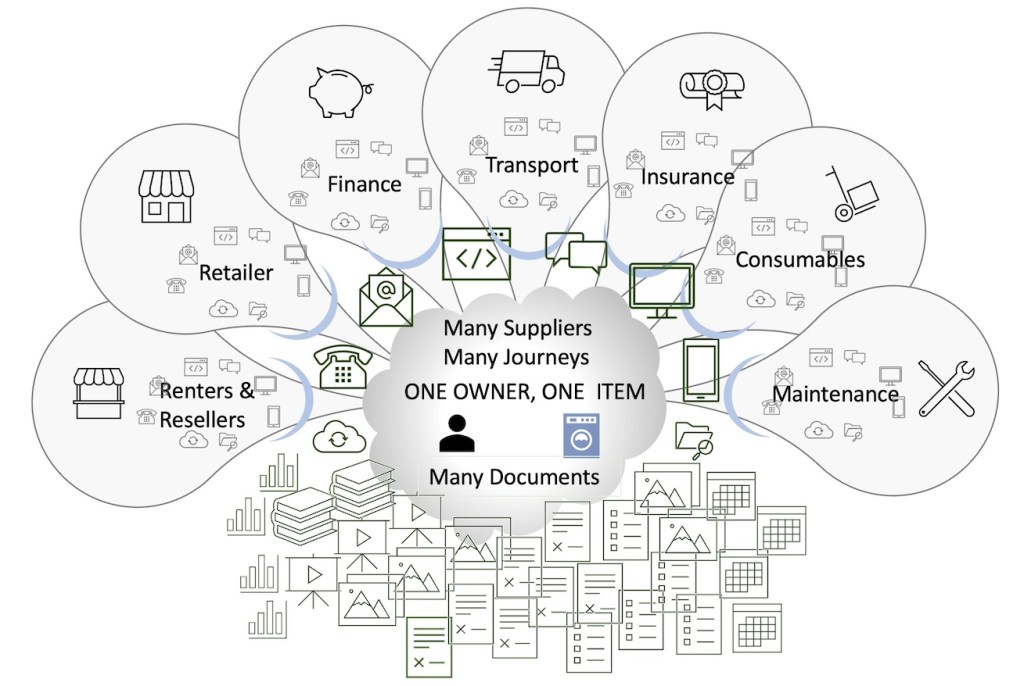
Customer Experience is the current tagline for everything a customer experiences when interacting with a supplier’s brand, products, and interfaces (human and digital). The actual customer experience is trying to manage a portfolio of disconnected services delivered by many suppliers, each focused on one narrow aspect of the overall need and all competing for attention. No one supports the owner’s primary goal – to easily acquire, use and look after an asset throughout its life.

Omni-channel is the current big thing in customer contact technologies that drive much of this experience. Offer customers many different channels to engage with the supplier. Synthesise all of the interactions in real time to maintain a ‘single view of the customer’ across the different customer touch-points and contact types through all stages of the customer journey.

Single View of Customer

To achieve this goal, a supplier needs a continuous stream of data; therefore, customer engagement must be as digital as possible. Digital agents are employed to manage the digital channels and as a bonus lower costs through automation and data processing efficiencies (for the supplier – not necessarily for the customer).

In most scenarios, the customer journey is that of a human, and often the goal of the human is to find and buy something and then ideally enjoy the use of that thing. Suppliers go to great lengths to make the customer’s journey with them as painless as possible; however, never question the assumption that the customer experience has to occur through their digital interfaces.

Customer interfaces are designed with humans in mind; however, they are tested in artificial conditions, assuming they have the user’s undivided attention. The interfaces are also judged on their ability to enable the customer to be served by the supplier – which is never the customer’s real goal.

The actual ‘customer experience’ is someone having to deal with many different suppliers employed to fulfil a narrow role, each pushing many different channels. The end goal of the customer is to enjoy something that depends on an ecosystem of suppliers to ensure that it continues to function and remains healthy. It isn’t to enjoy going through yet another registration process with yet another supplier that I will never have a ‘relationship’ with.

Owner and Item View

For each thing I own, I am subject to an array of omnivorous suppliers, all of whom are ‘offering’ me the opportunity to engage with them through one of many digital interfaces. Human-to-human interfaces are a last resort or costly luxury if they exist.

The supply of consumer goods and services has reached incredible levels of efficiency, offering an astounding abundance and variety of increasing specialisation and tremendous economies of scale. We’ve had fifty years of progress digitising old customer service models and transforming the customer experience of each supplier.

As responsible owners, it’s time we transform our experience. We cannot continue to take on more and more work, install more apps, to spend our time managing the supporting ecosystems for each of the things we care about. I’m looking for a supplier who cares about the owner experience – not one collecting more customer experiences.

Digital Twins – Separated at Birth

Imagine a digital representation of an object that includes every bit of data ever associated with it or related to it. I think this gets closer to a real digital twin than today’s pretenders. The emergence of these twins will give rise to unimaginable opportunities for the blended digital and material world in a true internet of and by things.

Today’s digital twins’ are like long-lost siblings, separated at birth, popping up in our network with chat messages and occasional photos. Our familiarity is less than superficial, and in the absence of a genuine relationship, we invent one. We don’t know where they’re from, what kind of life they’ve led, or whether they are actually related to their physical doppelgängers.

The typical twin family portrait is that of a big screen or AR goggles with a ‘live’ 3D view of a factory and machines that mirror the workplace outside the control room. In reality, the twins depicted on the dashboard could just as well be on Mars and are as ‘live’ as a thermostat. Our conception of a digital twin today is 90% imagination and 10% digital perspiration.

Sense, communicate, respond, analyse & visualise computing has been around for more than 50 years. The graphics, processing speed and volume of data has improved, our imagination enriched through glimpses of what’s possible, but the paradigm remains largely unchanged.

All manufactured objects (and many animals) are associated with a constant and growing stream of bits of recorded data from the moment of conception to disposal. By the time a product reaches the hands of a consumer, terabytes of data will have been collected, analysed and stored by thousands of stakeholders in millions of systems.

At the end of that journey, the consumer gets a nice origami cardboard box and a paper booklet in 30 languages explaining how to plug it in and switch it on. Enthusiastic owners can go fossicking for digital dust sprinkled across the internet in the wake of an item’s existence while the vast golden seems of valuable data remain sealed in their caves.

The scale of our digital waste and selfishness is mind-boggling. It may be cheap to store those zeros and ones, but the cost to society of keeping all those bits and pieces of information locked away in individual vaults is that we are doing less and less with more and more stuff.

If we’re going to keep this ‘digital twin’ terminology then let’s not sell ourselves short – let go all in!